chapter one — the word
A short book
about being
productively idle.
Everything you'd want to know about the studio, arranged as a slim volume. We kept it short because we respect your time and, honestly, ours. Start at the top or jump to whatever sounds least boring.
The word
on the door.
Miskincin. Turkish, invented, fondly worn. A compound that shouldn't work: miskin (idle, listless, a little feline) meets a suffix that makes it its own pleased opposite. It means lazy, but fast when the task earns it.
We chose it because it described us before we'd written a single line of code together. The kind of people who will rewrite a shell script for an hour to avoid six minutes of clicking. The kind of people who redesign the kitchen before making tea. The kind of people who build an app called Snap Split Your Bill because doing the arithmetic one more time was intolerable.
Laziness, in our reading, is not the absence of effort. It is an opinion about where effort should go. It should go somewhere permanent. Once. With taste.
“The lazy person and the engineer agree on more than you'd think. Both hate repetition. Both suspect most meetings. Both believe that the correct number of times to solve a problem is one.”
— internal memo, probably unsent
What we're
here to do.
We build small, stubborn, delightful applications that remove one specific frustration from a human day. Ideally a frustration we personally had, at high volume, the week before.
Make friction a first-class bug.
If a screen makes you sigh, we treat it the same way we treat a crash.
Use AI like a scalpel.
In the right places it disappears; in the wrong places it charges monthly.
Charge fairly, or don't charge.
Price transparency is a feature. Dark pricing pages are a red flag.
Build for ten years, not ten days.
We avoid architectures that will cost our future selves a weekend.
Design for the cook, not the menu.
Real workflows before feature lists. Always.
Rest is part of the plan.
We book it into sprints. Tired teams don't ship good work.
The long game
(played slowly).
Ten years out, we want to run a small, financially independent studio shipping a thin catalogue of apps that people keep on their home screen for years, not minutes.
Most software is designed to perform well in the first five seconds and forgotten by the thirtieth. We want the opposite. We want apps that age gracefully, that a user quietly recommends to their sibling, that don't need a quarterly redesign to remain a verb.
The distant vision is a catalogue of ten tools. Maybe fifteen. Each the shortest line between a small frustration and its resolution. Each still there a decade after launch, still understandable, still charging a fair price. A small, boring, wonderfully sturdy company.
We are in no hurry. That's rather the point.
- yr·1 Ship Souppo well. Learn on it. Delight the first thousand families. in progress
- yr·2 Ship Snap Split Your Bill. Replace one group-chat argument at a time. 2026
- yr·3 Add app #3, chosen not by market size but by personal annoyance. tbd
- yr·5 Be genuinely profitable on our own terms, or stop calling ourselves a studio. non-negotiable
- yr·10 A small, quietly famous catalogue of durable software. And a longer lunch. the plan
Things
we will not
build for you.
A short and slightly rude list, mostly for our own benefit. If any of these describe your brief, we'll send you to a competitor with a handshake and no ill will.
- ·no· Apps whose business model is boredom. infinite scroll, goodbye
- ·no· Subscriptions priced to punish you for forgetting to cancel. cancel in two taps or it's a bug
- ·no· AI features added because the word is on every competitor's landing page. vibes-driven roadmap
- ·no· Dark patterns. Pop-ups that pretend to be your friend. Guilt-coloured “No thanks” buttons. pattern ≠ persuasion
- ·no· Onboarding flows that outlive the actual product. seven screens of shame
- ·no· Data collection we wouldn't explain, out loud, to a concerned aunt. the aunt test
How we
actually work.
The shortest possible map of how things get made at Miskincin. Printed here mostly so we can stop explaining it at parties.
We use AI loudly, internally.
Behind the curtain, we lean hard on generative tools: code review, translation, content scaffolding, edge-case hunting. In front of the curtain, the user shouldn't have to know or care. AI is how we move quickly; it is not the product we're selling.
We prototype with the real thing.
No wireframes that lie. We build the tiny end-to-end version in the real stack and poke it on a real phone on a real commute. Decisions made in Figma die in the subway.
We write English like we mean it.
Product copy is a design surface. We argue about verbs the way other studios argue about border-radius. If a sentence wouldn't hold up in a magazine, it doesn't ship in our app.
We finish, then nap.
Sprints end on Fridays. Fridays end early. Monday is for reading what the users actually did with the thing. Rinse. Repeat. Try not to ruin it.
Things
you were
about to ask.
Wait, so what is "AI-first" here, actually?
Do you take on client work?
Why Istanbul?
Are you hiring?
Why do your pages look like a magazine?
Met us
(sort of).
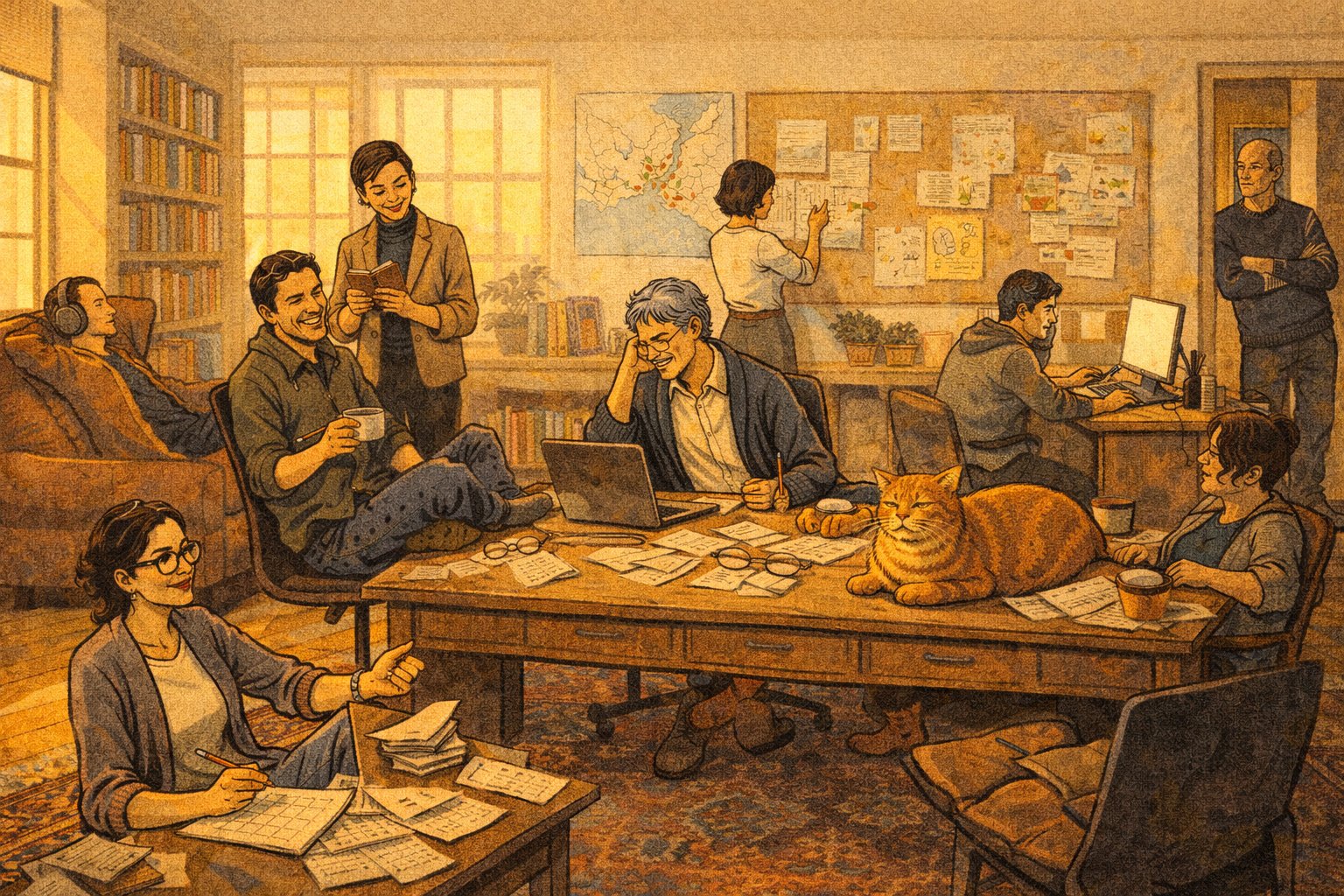
Keep reading if you enjoy portraits of small teams, or skip straight to the apps.